



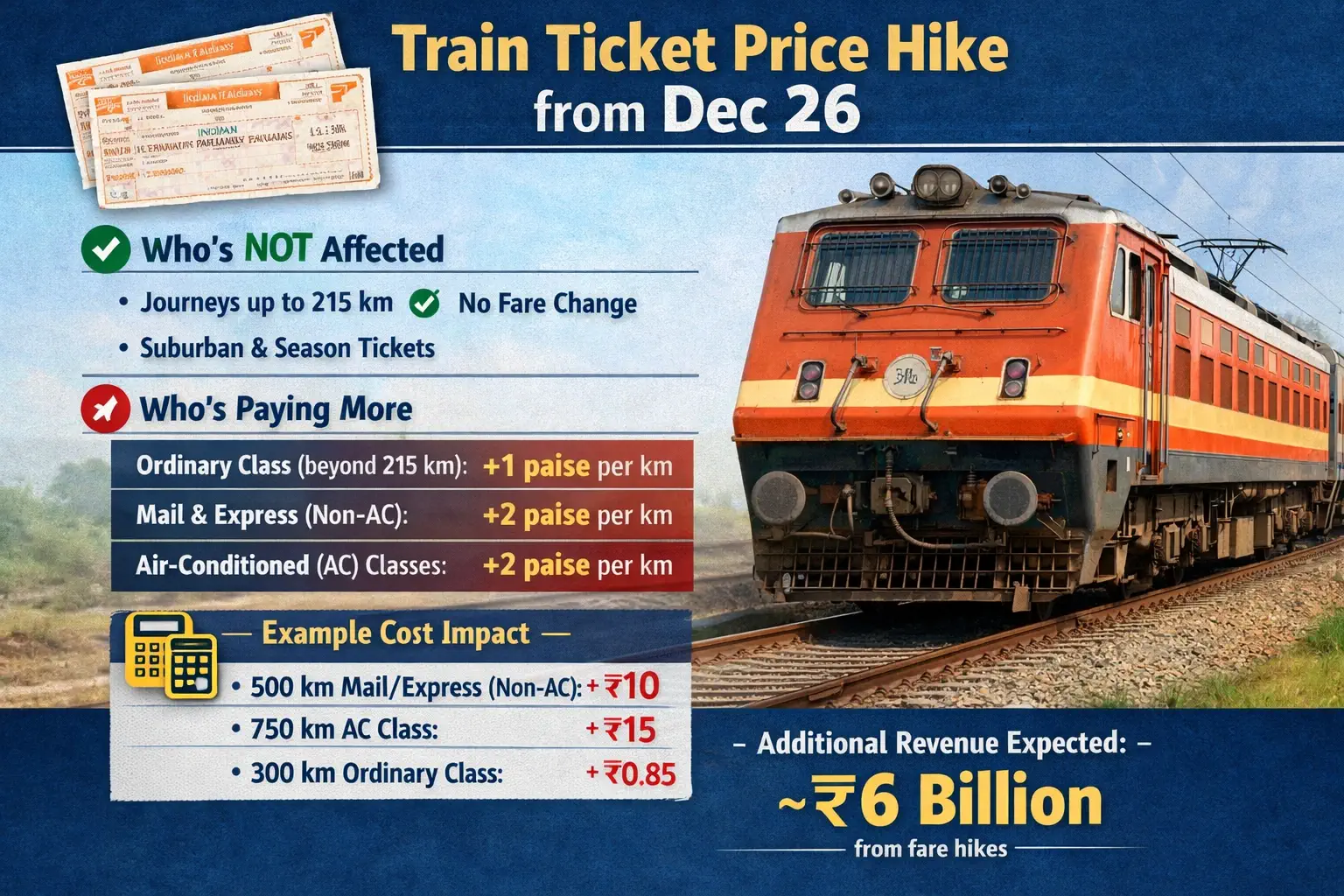
Train travel across India will become slightly more expensive from December 26, after Indian Railways announced a rationalisation of passenger fares. While the increase is modest, it will primarily affect long-distance travellers, especially those using Mail and Express trains.
The Railways clarified that short-distance and suburban passengers remain protected, keeping in mind its social responsibility and the needs of daily commuters.
No Change for Short-Distance and Suburban Travel
Suburban & Season Tickets
| Category | Fare Change |
|---|---|
| Suburban trains | No change |
| Monthly season tickets | No change |
Under the revised fare structure:
- No fare hike for journeys up to 215 km in ordinary (general) class
- Suburban train fares, including monthly season tickets, remain unchanged
- Passengers travelling within cities or nearby towns will not pay anything extra
This ensures that millions of daily commuters continue to travel at existing prices.
Fare Hike for Long-Distance Travel
The fare increase applies to longer journeys and is calculated on a per-kilometre basis, keeping the overall impact relatively low.
Revised Fare Structure
| Travel Category | Fare Increase |
|---|---|
| Ordinary class (beyond 215 km) | 1 paise per km |
| Mail & Express (non-AC) | 2 paise per km |
| Air-conditioned classes | 2 paise per km |
How Much More Will Passengers Pay?
Here are some illustrative ticket price impacts after December 26:
| Distance Travelled | Fare Increase | Extra Amount Payable |
|---|---|---|
| 300 km | 2 paise/km | ₹6 |
| 500 km | 2 paise/km | ₹10 |
| 750 km | 2 paise/km | ₹15 |
| 1,000 km | 2 paise/km | ₹20 |
While individual hikes appear small, frequent travellers and families on long routes may see costs add up over time.
Revenue and Financial Context
Indian Railways expects the fare rationalisation to generate around ₹6 billion in additional revenue during the current financial year.
However, officials stressed that passenger fares remain a secondary revenue source, with greater reliance on freight earnings. India has emerged as the second-largest cargo-carrying railway system globally, driven by higher freight loading and improved asset utilisation.
Why the Fare Hike?
According to Indian Railways, the revision aims to partially offset rising operating costs:
- Manpower expenses: ~₹11.5 billion
- Pension outgo: ~₹600 billion
- Total operational costs (2024–25): ~₹26.3 billion
Over the past decade, the Railways has expanded its network, added new trains, and strengthened safety infrastructure—leading to higher expenditure.
Not the First Increase
This is not the first fare revision in recent years. In July, fares for Mail and Express trains were raised for the first time since January 2020.
What It Means for Passengers
For most travellers, the hike is unlikely to significantly disrupt travel budgets. However, long-distance passengers are advised to plan ahead and factor in marginal increases, especially for multiple journeys.

 No products in the cart.